There is a kind of riding that does not happen on smooth tarmac between point A and point B. It happens on dirt tracks through forests, on rocky mountain paths, on river crossings, on loose gravel descents where your tyres hunt for grip and your heart rate climbs along with the trail. It happens when you turn off the main road simply because you want to see what is around the corner, and the corner leads to another corner, and suddenly you are somewhere genuinely wild and genuinely alive.
Adventure and off road riding has grown enormously in popularity over the past decade, and it is not hard to understand why. There is something about leaving sealed roads behind that strips the riding experience back to something more primal and more satisfying than any highway ride can offer. But doing it well, and doing it safely, requires more than a willing attitude and a bike that technically moves. It requires a bike that is properly set up for the conditions it is going to face.
Most bikes that come out of showrooms are compromises. They are designed to be acceptable in a wide range of conditions rather than excellent in specific ones. For adventure and off road riding, that means the stock setup often falls short in exactly the areas that matter most when things get rough. The tyres are not right for loose surfaces. The suspension is tuned for road comfort rather than trail control. The protection for the bike and rider is minimal. The ergonomics are designed for sitting, not for the active, standing riding position that technical terrain demands.
This blog is going to walk you through the modifications that genuinely make a difference for adventure and off road riding. What to change, why it matters, how to prioritise if your budget is limited, and how to think about building a bike that is ready for wherever you want to take it.
Start With the Tyres Because Nothing Else Matters as Much
If there is one modification that transforms the off road capability of a bike more than any other, it is the tyres. This is not an exaggeration. A bike with mediocre suspension and proper off road tyres will outperform a bike with excellent suspension and road tyres on dirt and gravel every single time. Tyres are the only contact point between the bike and the surface, and their ability to find grip on loose, wet, rocky, or muddy terrain determines almost everything about how the bike handles.
Road tyres and even road-biased adventure tyres have shallow, closely-spaced tread patterns designed to clear water on tarmac. On dirt, these patterns fill with mud or dust almost immediately and become effectively slick. Proper off road tyres have widely spaced, deep knobby tread blocks that bite into loose surfaces, self-clean as the wheel rotates, and provide the mechanical grip that friction-based road tyres cannot deliver on unpredictable terrain.
The choice between a 50/50 tyre, meaning equally capable on road and off road, and a more aggressive 70/30 or 90/10 off road biased tyre depends on how you ride. If most of your riding is on road with occasional dirt sections, a 50/50 tyre like the Metzeler Karoo Street or Michelin Anakee Adventure makes sense. If you spend more time off road than on, a more aggressive option like the Michelin Desert Race or Maxxis Enduro gives significantly better capability in the dirt at the cost of faster road wear and more noise on tarmac. Knowing your actual riding ratio honestly, not what you aspire to but what you genuinely do, helps you pick the right tyre for your real usage.
Run lower pressures off road than you would on the road. Dropping tyre pressure to around 1.5 to 1.8 bar off road, compared to the standard 2.2 to 2.5 bar for road use, increases the contact patch, improves compliance over rocks and roots, and dramatically improves traction on loose surfaces. Carry a small pump or CO2 inflators so you can adjust pressure for different surfaces and re-inflate before returning to the road.
Suspension: Making the Bike Work With the Terrain
Stock suspension on most adventure-capable bikes is tuned for a combination of road comfort and light off road use. For serious off road riding, this tuning is usually too soft in terms of damping, meaning the suspension moves through its travel too quickly and bottoms out or wallows on rough terrain, and often too stiff in terms of spring rate for a loaded adventure bike carrying luggage and camping gear.
Suspension setup starts with getting the sag right. Sag is the amount the suspension compresses under the weight of the rider in riding gear in the normal riding position. The correct sag figure varies by bike and riding style but for off road use is generally set with slightly more sag than road settings, as this keeps the suspension more in the middle of its travel where it can respond to bumps in both directions. Most bikes have adjustable preload that allows sag to be set without replacing springs.
Revalving the suspension, which involves disassembling the forks and rear shock and modifying the internal valve stack to change how damping forces build up through the stroke, is the most effective way to improve suspension performance for off road use. This is specialist work that requires a suspension technician, but the transformation in how a bike feels on rough terrain after a proper revalve is dramatic. The bike becomes more composed, more predictable, and significantly easier to control.
For bikes where the stock suspension is fundamentally inadequate for serious off road use, aftermarket suspension components from companies like Ohlins, WP, or Nitron offer significant performance improvements. These are significant investments but for riders who spend serious time in demanding terrain, the difference in control and confidence is worth it.
Fork guards are a simple and inexpensive modification that protects the fork sliders from rock strikes and debris that can scratch and pit the surface, leading to seal damage and oil leaks. On any bike that sees genuine off road use, fork guards should be considered essential rather than optional.
Protection: For the Bike and For You
Off road riding involves falls. Not necessarily serious ones, but slow speed tip-overs on technical terrain, getting a wheel stuck, misjudging a slope, are all part of learning to ride off road and even experienced riders have their moments. Protecting the bike from these inevitable contacts with the ground makes the difference between a minor inconvenience and an expensive repair.
Engine guards and bash plates are the first protection modifications to consider. The bash plate is a metal or heavy-duty plastic plate that bolts under the engine and protects the engine cases, oil pan, and exhaust headers from rock strikes. Many adventure bikes have vulnerable engine cases that protrude below the frame and a single significant rock strike can crack a case and leave you stranded far from help. A bash plate addresses this completely and is one of the best value modifications for off road use.
Engine bars, sometimes called crash bars or engine guards, bolt to the frame on either side of the engine and provide a protected zone that takes the impact of a fall before the engine, footpegs, and bodywork do. On a big adventure bike, a fall without engine bars can crack a cylinder head cover, break a footpeg mount, or damage bodywork. The same fall with engine bars typically leaves the bike unscathed because the bars take the contact.
Radiator guards protect the radiators on liquid-cooled bikes from stone strikes that can puncture the thin aluminium fins and cause coolant loss. They are inexpensive, lightweight, and on bikes with exposed radiators an obvious addition.
Hand guards protect both your hands and the clutch and brake levers in a fall. A broken lever in the middle of nowhere is a serious problem. Hand guards significantly reduce the chance of lever breakage in tip-overs and also provide useful wind and debris protection for your hands during riding. Bark Buster style guards that attach to both the bar end and a clamp on the handlebar provide the most robust lever protection and are worth the modest additional cost over guards that only attach at the bar end.
For your own protection, off road riding demands different gear than road riding. A helmet with a visor peak and a chin guard designed for off road use allows you to ride standing up while looking at the trail ahead without wind blast problems that open-face road helmets create. Knee braces or at minimum knee guards protect one of the most vulnerable joints in a low-speed off road fall. Off road boots with ankle protection and a stiff sole are significantly more protective than road boots on technical terrain where your feet are regularly in contact with rocks, roots, and uneven surfaces.
Ergonomics: Riding Position for Off Road Control
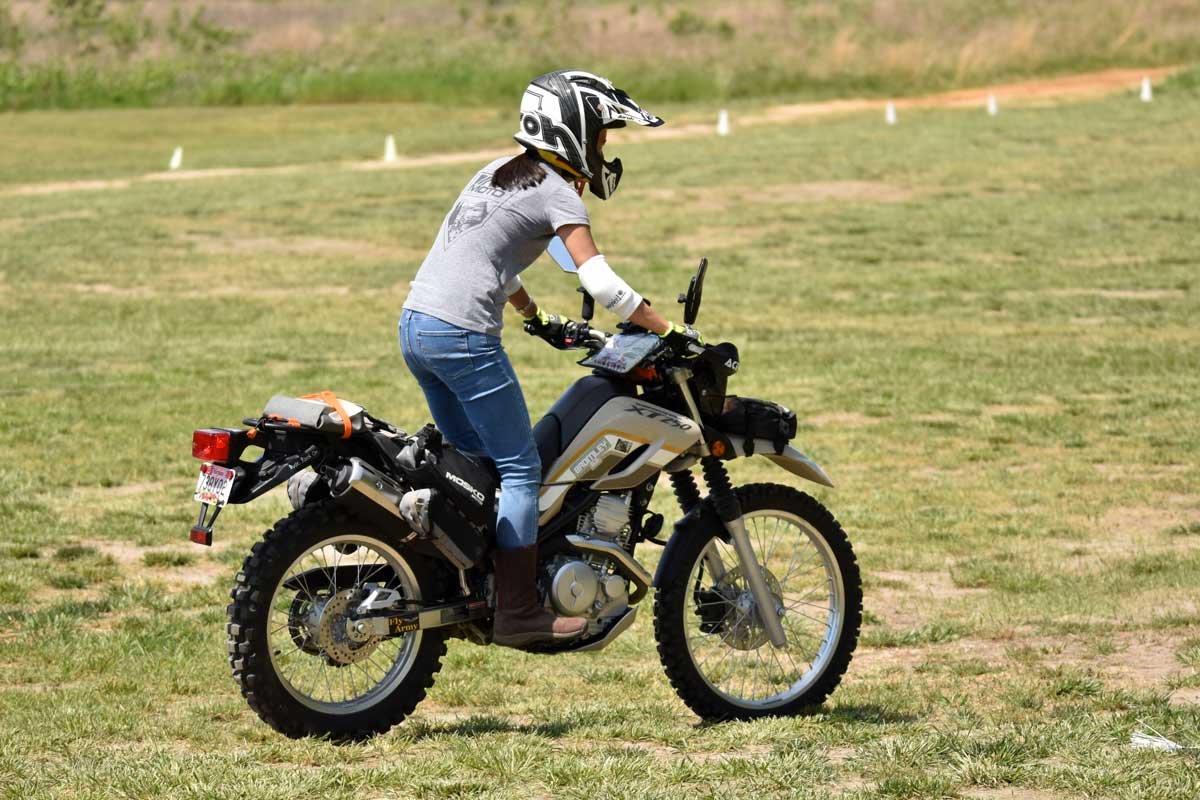
Proper off road riding technique involves spending much of your time standing on the footpegs rather than sitting in the seat. Standing lowers your centre of gravity relative to the bike, allows your legs to absorb terrain impacts rather than transmitting them through the seat to your spine, gives you better visibility of the trail ahead, and allows you to shift your weight quickly and precisely in response to what the terrain is doing.
Most adventure and off road bikes have footpegs that are positioned and sized for road riding. Wider footpegs give a more stable platform for standing riding and reduce fatigue over long off road sections. Several aftermarket options are available for most popular adventure bikes and the improvement in comfort and control from wider pegs on long off road days is significant.
Handlebar position is critical for standing riding. Bars that are too low force you into a bent-over position that is tiring and reduces control when standing. Risers that raise the bars by 20 to 40 millimetres often make a significant difference in comfort and control for taller riders or for bikes that are slightly bar-low from the factory. Check that raising the bars does not put the cables and brake lines under excessive tension before fitting.
A seat that is correctly positioned, at a height that allows you to get a foot down confidently on technical terrain without requiring you to be too low for effective standing riding, is something that many taller riders modify. Aftermarket seats at different heights, or foam modification by an upholstery specialist, can tailor the seat height to your leg length and riding style.
Lighting and Navigation
Riding in remote areas means that if you are still on the trail at dusk, or if you enter a dark gully or forest section, the stock headlight on most bikes may not provide adequate illumination for the speeds and terrain involved.
Auxiliary LED lights are a popular addition to adventure bikes and for good reason. A pair of well-positioned auxiliary lights dramatically improves visibility and reduces fatigue on night riding or in low-light conditions. Position matters as much as brightness. Lights mounted at a lower position on crash bars or fork legs provide ground-level illumination that reveals rocks, ruts, and roots more effectively than lights mounted high that tend to reflect back off the trail surface.
Navigation is a genuine consideration for off road riding where GPS tracks and paper maps matter more than phone signals and road signs. A dedicated GPS unit mounted on the bars in a ruggedised case provides reliable navigation without depending on mobile network coverage that will not exist in remote areas. Mounts that absorb vibration protect both the device and the mount itself from the constant movement of off road riding.
Luggage and Carrying Capacity
Adventure riding usually means carrying things. Camping gear, tools, spare parts, food, water, and clothing all need to go somewhere, and how you carry them matters for both the handling of the bike and the practicality of access during the ride.
Soft luggage, in the form of drybags, tank bags, and saddlebags, is flexible, lighter than hard luggage, and more forgiving in the event of a fall because it compresses rather than shattering. For off road use, soft luggage is generally preferred over hard panniers because it does not extend the width of the bike as rigidly, making it easier to manoeuvre in tight terrain, and because a fall on hard panniers can damage them significantly.
Rack systems that mount to the subframe provide a stable base for drybags and roll bags and allow load to be carried high on the bike, though for serious off road use keeping weight low and central improves handling. A small tail bag and a tank bag rather than large side loads keeps the weight distribution closer to ideal for technical riding.
Carry the essentials for self-recovery on any serious off road ride. A tube patch kit and tyre levers, a small pump, a basic tool kit appropriate for your bike, zip ties, duct tape, a length of wire, and a tow strap together weigh very little and have collectively rescued countless riders from situations that would otherwise have required external help.
Building Your Bike Over Time
The best approach to adventure and off road modifications is the same approach that works for most things in life. Start with what makes the most difference, do it properly, and build from there.
Tyres first, always. They cost least and matter most. Protection second, because what you cannot fix in the field can end your ride. Suspension when you have the budget and have spent enough time on the bike in off road conditions to know what it needs. Ergonomics and accessories after that, shaped by what your specific riding has taught you about what would make the biggest practical difference.
The riders with the most modified bikes are not always the ones having the most fun. The rider with a thoughtfully modified bike that suits their actual riding, their budget, and their level of experience is almost always having a better time than the one who spent a fortune on modifications before they knew what they actually needed.
Go ride. Learn from what the terrain demands. Modify accordingly. And then go ride somewhere more challenging.
The trail is waiting.